
As India moves towards a more resource efficient future, one question is becoming increasingly important: how can we build a textile industry that generates less waste and makes better use of existing resources?
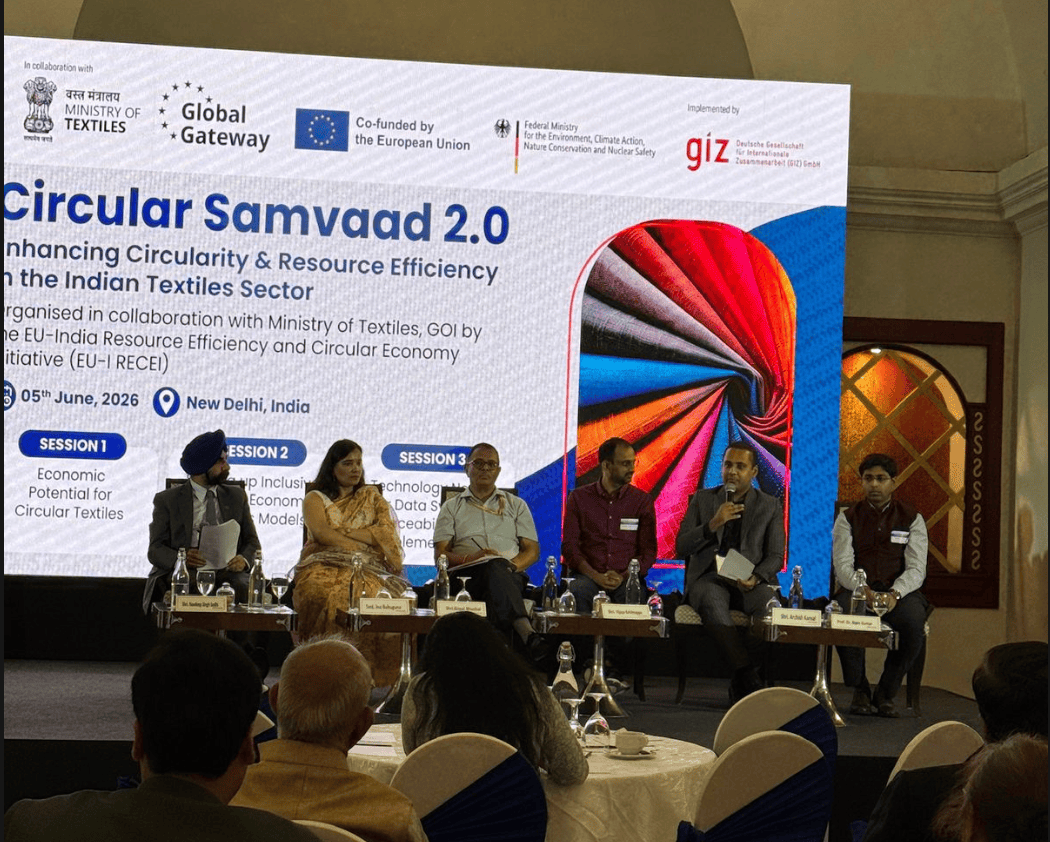
The question is what started the discussion for Session 3 of Circular Samvaad 2.0, organised under the EU- India Resource Efficiency and Circular Economy initiative on world environment day 2026 in New Delhi. The session brought together policymakers, industry leaders, recyclers, researchers, and technology experts to discuss the role of technology, traceability, and innovation in creating scalable and economically viable circular textile value chains.
The discussion surrounded a common theme: circularity is no longer just an environmental objective. It is becoming a business necessity for India’s textile sector.
Our CEO and Founder Mr. Archish Kansal shared his key insights as a panelist, he highlighted a practical reality that is often overlooked, that is recycling systems only work when they work in the real world. According to him, building a commercially viable recycling ecosystem requires much more than technological innovation. It depends on strong collection networks, active community participation, reliable supply chains and market demand for recycled products.
In simpler words, technology cannot solve the textile waste problem on its own. This perspective is especially relevant in India, where textile waste management operates across a highly fragmented system building households, informal waste collectors, sorting facilities, recyclers, manufacturers, and brands. Any solution must account for these realities.
The emphasis in the discussion was placed on the importance of balancing investments in digital technologies with operational needs on the ground. While data and traceability can improve transparency and efficiency, equal attention must be given to building the physical infrastructure that supports the process of collection, sorting and processing in the real world.
The discussion therefore reinforced an important idea: the future of textile recycling will be shaped by the ability of the industry leaders to connect innovation with practical implementation.
As India transitions towards a circular textile economy, the challenge is no longer about developing better recycling technologies. It is about creating systems that are scalable, viable and accessible to the communities that make recycling possible in the first place. Because true circularity is about ensuring that every part of the circular ecosystem works.