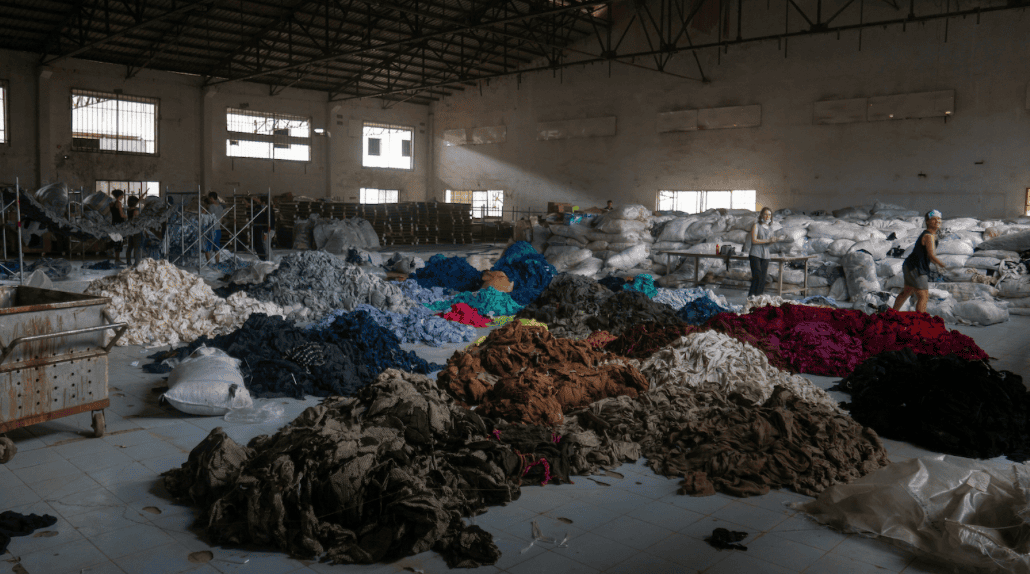


Uniforms are designed for repetition, to be worn daily. This leads us to assume they do not contribute to fashion waste. However, that’s far from the truth, with a bulk production, what happens to these uniforms when a student graduates, or when a worker retires? Once outdated, damaged or replaced by new branding they exit this cycle of repetition and end up in informal waste streams or what we call landfills.
This leads to uniforms being one of the most overlooked opportunities for circularity.
Corporate and institutional workwear falls at the intersection of consistency and volume. Schools, hospitals, and offices collectively circulate millions of uniforms every year. Unlike personal clothing, uniforms follow predictable lifecycles which are defined by use periods, and standardised use of raw materials. From a circular design perspective, this makes them a key element for structured reuse and recycling systems.
Yet most uniforms do not conform to the circular model i.e. they remain linear.
New Uniforms are produced. Old ones are discarded. The material value in these garments with respect to fabric, energy, labour is lost at the end of each cycle. This is not just an environmental issue, it’s a system set for failure. When organisations treat uniforms as disposable assets, waste becomes inevitable.
Rethinking uniforms means redesigning and redefining the system of corporate workwear. Circular uniforms begin with material choices- selecting fabrics, which are easy to recycle and that are durable. They continue with traceability- a sense of awareness by organisations to know how many uniforms do they produce and how many are in circulation and being aware of their condition. This requires what we mentioned in the previous blogs as “Reverse supply Chain logistics.”
Beyond the realm of sustainability, circular uniforms offer operational benefits. It reduces misuse and leakage. Recycling programs ensure brand protection by preventing old uniforms from entering informal markets. And the transparency involved in these systems ensure that organisations meet growing ESG and compliance expectations.
Most importantly, circular uniforms shift responsibility from individuals to institutions. Instead of imposing employees and students to “figure out” the right method of disposal, these organisations design systems that handle it responsibility, ensuring circularity in end- to end processes.
At Respun, we see uniforms not as waste which is delayed, but are as resources which need to be injected back into circulation. By helping institutions understand the circular loop on workwear, we aim for a future where uniforms don’t just represent belonging and community but rather they also represent accountability for the future, and environment.